

In the last few weeks, California’s governor Jerry Brown has received two letters about climate change. One recommends that he should take meaningful action on climate change. The other recommends that he should provide a loophole to allow the oil industry to continue polluting.
Letter 1: Stop drilling for oil
Two Democratic members of Congress, Ro Khanna and Barbara Lee wrote to Brown earlier this week asking him “to announce an end to new fossil fuel projects in our state and a just transition plan ending California’s existing oil and gas production”.
The letter is available here.
It mentions climate change, air pollution, and the impacts on low income communities of continued oil drilling in California. The lawmakers point out that there are more than 3,000 oil wells in Los Angeles County alone. Many are less than 90 metres away from residential areas.
They write that,
We regularly hear from constituents about the tremendous burdens that fossil fuel production places on our communities, especially low-income communities and communities of color. California is home to some of the country’s most polluted air basins. The pollution from oil and gas field operations and refinery facilities is a major contributor to the array of air quality related health problems that hurt our most overburdened communities.
The letter supports an April 2018 letter that asks Brown to stop new fossil fuel projects and to phase out existing production. More than 800 organisations have signed on to the letter. A campaign called #BrownsLastChance is aiming to get Brown to pull out of fossil fuels:
Meanwhile, 165 elected officials have signed a letter to Governor Brown urging him to phase out fossil fuel production in California. They point out that “The science is clear”.
Letter 2: REDD – A dangerous distraction
The second letter comes from a group of scientists led by Dan Nepstad of the Earth Innovation Institute. They ask Jerry Brown to include carbon credits from tropical forests in California’s cap-and-trade scheme.
Most of the people signing on are forest scientists. Nevertheless, they claim to be “scientists who have devoted our careers to understanding and solving climate change and other threats to the capacity of the Earth to sustain human civilization”.
Their proposal is a dangerous distraction from the urgent need for Governor Brown to stop fossil fuel extraction in California. The letter doesn’t mention fossil fuels once.
Brown worked closely with the oil industry on California’s climate policy. It’s an oil friendly carbon trading scheme.
The scientists’ letter is available here.
Just about every sentence is either misleading, or downright false.
Brown is not green
The letter applauds Jerry Brown for his “global leadership in making California a beacon of hope to the world that the battle against climate change can be won”.
But as investigative journalist Dan Bacher points out, the reality is that under Jerry Brown, California has seen a huge expansion of new offshore drilling. For example, from 2012 to 2016, 238 new offshore oil wells were approved in state waters off Los Angeles and Ventura counties.
New offshore leases have been banned in California since 1984 – the new oil wells are in existing leases. Brown could close down existing leases and wells, as Khanna and Lee suggest he should in their letter. Instead, Brown keeps his cosy relationship with Big Oil and allows offshore drilling to expand.

And it’s not only offshore drilling. During Brown’s administration, more than 20,000 permits for new drilling have been issued.
Almost 8,500 active oil and gas well in California are within 0.75 kilometres from homes, schools, and hospitals. The California Council on Science and Technology states that the greatest health risks occur within this distance from active oil and gas development
To address climate change, leave the oil in the soil
The scientists’ letter states that, “The best science points to an important part of the climate change solution that you are uniquely positioned to unlock: tropical forests.”
But this “best science” is based on a scientific fraud: that the carbon stored underground in fossil fuels is climatically the same as carbon stored above ground in forests.
The reality is that carbon stored underground as fossil fuels is stable and will only enter the atmosphere if it is dug out and burned. Carbon stored in forests is inherently unstable. Forests burn. Forests are destroyed by pests. Forests are logged, flooded to created reservoirs, and cleared to make way for mines, cattle ranches, or industrial plantations of soy, palm oil, or pulpwood.
Research published in Nature magazine in 2015 found that the Amazon is losing its capacity to absorb carbon. Over the past ten years, the carbon absorbed by the Amazon each year has decreased by about one-third.
Tropical deforestation ≠ 20% of global emissions
The scientists’ letter states that “deforestation and degradation of tropical forests” is “the source of as much as one fifth of global emissions”. The source given for this statement is the Intergovernmental Panel of Climate Change (2014), Working Group III.
But Working Group III’s Summary for Policy Makers includes the following graph, which clearly shows that in 2010 global emissions from Forestry and Other Land Use accounted for 11% of global emissions (+/- 50%):
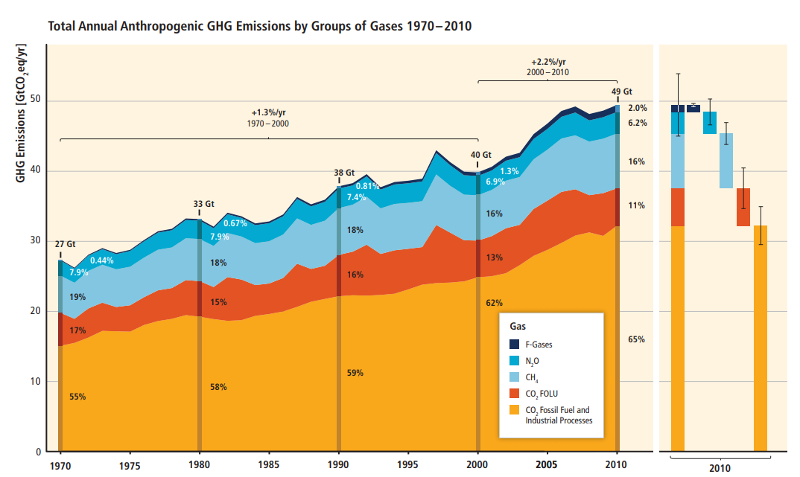
Since then, emissions from fossil fuels have continued to increase. And three of top five countries with the highest deforestation rates are Russia, Canada and the United States. These three countries together account for almost half of all global deforestation.
It is simply untrue to state that emissions from tropical deforestation account for 20% of global emissions. As the graph above shows, emissions from fossil fuels is by far the largest source of greenhouse gas emissions globally.
Brazil is not a “success” story
The scientists’ letter states that in “many places”, governments of tropical forest regions are slowing deforestation.
The only example of this slowing deforestation given in the scientists’ letter is that of Brazil. The letter states that Brazil has “drastically reduced deforestation of the Amazon forest, avoiding more than six billion tons of carbon dioxide emissions since 2005”.
The source given for this statement is a 2014 paper published in Science. Nepstad was the lead author.
In the paper Nepstad and his co-authors ask “Why did deforestation decline?” They argue that it was a result of the improved law enforcement, the Soy Moratorium, rapidly rising beef yields (and a reduction in the number of cows in the Amazon), an expansion of protected areas, and delays in highway paving.
REDD was not one of the reasons for reduced deforestation.
Philip Fearnside, an ecologist with the National Institute for Research in Amazonia, is one of the world’s leading experts on the Amazon. He argues that the reduction in deforestation between 2004 and 2007 was “virtually all due to market forces”. During that period the price of soy and beef fell, and the Brazilian real increased in value by 80% compared to the US dollar. As a result exports became less profitable.
As the graphic below shows, deforestation did fall dramatically in the Brazilian Amazon from 2004 to 2007:

Brazil announced the Amazon Fund, with US$1 billion in results-based payments from Norway, in December 2008 (that’s the dotted line on the graphic above). Between 2009 and 2014, deforestation remained more or less steady.
But since 2014, it has been going back up.
As Sue Branford and Maurício Torres reported recently in Mongabay, Brazil’s current political crisis is driving deforestation higher:
According to the new figures published by IMAZON, the rate of deforestation for the whole of the Amazon basin rose by 22 percent between August 2017 and May 2018, compared with the same period the previous year. Perhaps more importantly, forest degradation was up by 218 percent. Degradation is often followed by deforestation.
In June 2018, deforestation reached an area of 1,168 square kilometres – the highest monthly area since Imazon started monthly deforestation reports in April 2007.
The scientists letter: Bad for California, bad for forests, bad for the planet
The scientists’ letter ignores Brown’s record on approving the expansion of oil drilling. It uses a scientific fraud to equate stable carbon, stored in fossil fuels underground, with unstable carbon, stored temporarily in forests. The letter uses an exaggerated figure for the percentage of greenhouse gas emissions coming from tropical forests. The only example it can give of reduced deforestation is Brazil, where deforestation is currently skyrocketing.
And the letter makes no mention of the fact that generating REDD carbon credits for sale in California would allow continued pollution from the fossil fuel industry. Which would accelerate climate change, increase the health impacts for communities living near oil and gas operations in California, and put forests worldwide at ever greater risk of going up in smoke.
There are many good reasons to address deforestation. But to address climate change, we need to leave fossil fuels in the ground.