

By Chris Lang
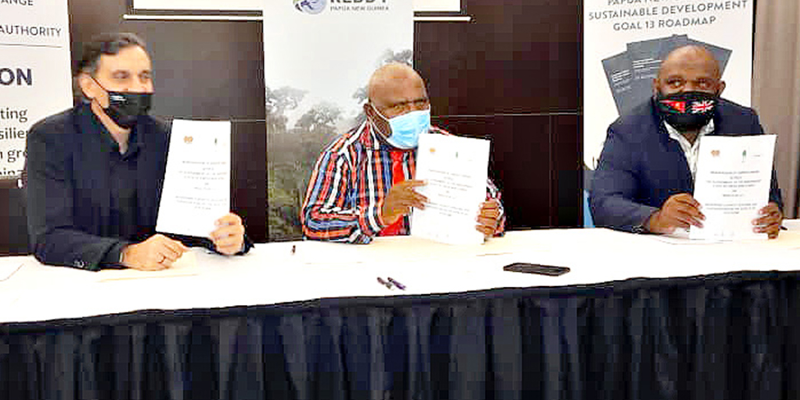
Kevin Conrad, the Executive Director of the Coalition for Rainforest Nations, was back in Papua New Guinea earlier this month. He travelled there to sign a Memorandum of Understanding about selling carbon credits generated from PNG’s forests.
The MoU was signed on 17 March 2021, by Kevin Conrad, Wera Mori, PNG’s Minister for Environment, Conservation and Climate Change, and Ruel Yamuna, Managing Director of the Climate Change Development Authority. According to an article in the Post Courier, “The MoU pursues the conversion into cash the carbon credits that have been absorbed by the PNG rainforests.”

Conrad is quoted as saying that,
“This is a big event globally as this is the very first time that (carbon) credits that have been approved by the UNFCCC are being marketed to an open forum to our consumers.”
For several years, Conrad has been claiming that the Coalition for Rainforest Nations carbon credits are “compliant with UNFCCC decisions”. In 2017, the Coalition for Rainforest Nations attempted to register “REDD+” as a trademark. At the time, Conrad explained to REDD-Monitor that,
The objective simply is to register a REDD+ logo to distinguish REDD+ actions that are compliant with UNFCCC decisions vs. those that the Voluntary Carbon Standards falsely call REDD+ based on project standards long rejected by the UNFCCC and the international community for poor environmental and atmospheric integrity.
Kevin Conrad’s REDD+ Results Units™
The Coalition for Rainforest Nations has registered the term “REDD+ Results Unit” as a trademark. CfRN also set up the website REDD.plus and created the REDD.plus Registry, which is administrated by the IHS Markit Registry.
Here’s how CfRN explains what REDD+ Result Units™ are:
Each carbon credit or REDD+ Result Unit™ is issued by the national government to prevent leakage, eliminate double counting and seamlessly integrate into the global carbon accounting. REDD+ Result Units™ are only made available after conservation efforts have been successful and independently reviewed by the UNFCCC. REDD+ Result Units™ are registered on the UNFCCC REDD+ Information Hub, and we retire them upon sale.
The REDD.plus website states that PNG has more than 9 million REDD+ Results Units™ available. This figure comes from the government of Papua New Guinea’s submissions to the UNFCCC.
PNG’s December 2018 First Biennial Update Report states that, “The technical annex presents the REDD+ results (results measured against the technically assessed FRL) achieved by PNG between 2014 and 2015 which was 9,003,314 tCO2e.”
In 2014 and 2015, PNG emitted slightly less than 40 million tCO2e from deforestation and forest degradation, according to the government’s submission to the UNFCCC. Global Forest Watch data indicate that PNG lost 58,500 hectares of primary forest in 2014, and 77,900 hectares in 2015.
Despite these levels of deforestation and emissions, PNG can claim to achieved “REDD+ results” because it created a Forest Reference Level that increases steadily each year. PNG’s Forest Reference Level simply extrapolates the doubling of emissions from deforestation and forest degradation that took place between 2001 and 2013.
This graph in PNG’s First Biennial Update Report shows how the rate of deforestation can remain at historically high levels and still generate “REDD+ results”:

So far REDD.plus is only offering REDD+ Results Units™ from Papua New Guinea, but Belize, Uganda, and Ghana are listed on the website as “coming soon”.
Free, Prior and Informed Consent?
The Post Courier reports Wera Mori, PNG’s Minister for Environment, Conservation and Climate Change as saying that,
“This MoU signing is going to lock out all little private arrangements, and will give the state an attraction on what is happening to the carbon credits the country has.”
That must come as quite a shock to the developers that have set up REDD projects in the country.
Even more worrying is how Mori and Yamuma can claim to make decisions about the sale of carbon credits from forest that is under customary ownership. No process of Free, Prior and Informed Consent was carried out before the MoU was signed.
On the REDD.plus website, CfRN explains that “Rainforest nations and their communities receive over 90% of sale proceeds to support their ongoing work protecting rainforests.”
But there’s an enormous difference between money going to a government and money going to the communities that are protecting the forests. PNG has not yet produced a REDD benefit sharing agreement, and it is far from clear exactly where the money raised from sales of REDD+ Results Units™ will end up.
Meanwhile, on the REDD.plus website, the Coalition for Rainforest Nations is selling REDD+ Results Units™ from PNG for US$11 each.

Blackstone Energy Services
The Post Courier reports Conrad as saying that,
“Once we get everything signed up we are going to do a transaction next week, probably just a small one, about US$10,000, just to show and announce that the system is up, and all consumers need to show a transaction to bring other people in.
“We have a company in Canada called the Blackstone Energy, who will be the first company to buy from PNG and their idea is just to get the game started.”
Conrad seems to be referring to a company called Blackstone Energy Services Inc. The company describes itself as “an energy management company that delivers purposeful change for clients by guiding large businesses, municipalities and hospitals on their journey to net-zero consumption.”
There’s no mention of Papua New Guinea on the company’s website. I’ve not been able to find any announcement of any purchase of REDD+ Result Units™ from Papua New Guinea.
It is another irrational twist of human “logic” to take credit for an existing part of this planet’s eons-old carbon-sequestering efforts. Under oxygen pricing, these countries and peoples would simply be paid to leave the forests intact, rather than having to concoct this pitiful scheme of selling off imaginary “credits”. The funding for this would come for charging those who steal oxygen from the commons for its use in oxidizing their fuels. And you can balance that set of books, unlike the various book-cooking schemes for carbon “pricing”.
Chris, Usually I find your take unusually pessimistic, but with this one I have to agree. I will not comment on the reference level calculation, because I know FAO has spent years helping PNG calculate that and its a highly technical discussion, but no FPIC, no benefit sharing agreement in place and top down decision making and administration of funds is a recipe for disaster. Ting ting bilong me tasol.
we exited an Agreement with CfRN when they deaulted on a Registry and Exchanged contracrt at the first hurdle. Beforew that deault by them i was shocked and appalled to find when their lawyers sent the conracts back they claimed to have Registered the REDD+ Trademark and CfRN wanted to OWN the rights for every REDD+ Credit issued worldwide. i reuifsed to accept that clause and did not hesitate to inform the UNFCCC whose lawyers intervened. when they lodged their application for aproval for CORSIA with ICAO i was again shocked and appalled at how they palgeurised the UN , UNFCCC and REDD + brands to get apoval for a so called ‘credti standard’ where the beneficiaries are mainly KC & partners not the projects.
we have sold many PNG Forestry credits with $hundreds of thousands to the proejct owenrs – but now i know why they have dried up