

By Chris Lang
In September 2019, the President of the Republic of Congo, Dénis Sassou Nguesso, flew to Paris to meet Emmanuel Macron, France’s President. Macron signed a letter of intent committing US$65 million to the Central African Forest Initiative (CAFI) to protect the Republic of Congo’s forests.
A few weeks earlier, on the Republic of Congo’s 59th Independence Day, Sassou Nquesso announced that a Congolese oil company, Petroleum Exploration and Production Africa (PEPA), had discovered an oil field – the Ngoki Block – with 359 million barrels of oil.
Recent research by Global Witness, the Spiegel, Mediapart, and European Investigative Collaborations reveals that the environmental impact assessment almost entirely pre-dated the discovery of a huge deposit of peat in the Cuvette Centrale. Almost two-thirds of the Ngoki Block is peatland. Yet the environmental impact assessment included no analysis of the risk to the peatland from oil drilling.
Global Witness describes the Cuvette Centrale as “one of the biggest carbon time bombs on the planet” – if the region were to be exploited by oil companies.
In his speech in August 2019, Sassou Nguesso mentioned the “presence of high-grade reserves” in the Ngoki Block. “Then Sassou-Nguesso turned his attention to the environment,” Sven Becker and Fritz Schaap write in the Spiegel.
Environmental blackmail
President Sassou Nguesso said he wanted to “serve humanity” by protecting the peatlands. And Global Witness reports him as saying that,
“Our country has never ducked the obligation to protect the peatlands and has no intention of doing so.”
Protecting the environment is a recurring theme with Sassou Nguesso.
In 2016, during COP 22 in Marakesh, he launched the Congo Basin Blue Fund, with plans to raise US$100 million by 2020. The Environment Ministry in Berlin told Becker and Shaap that Germany contributed €550,000 to the “Fonds Bleu”.
In March 2018, Sassou Nguesso hosted the third meeting of the Partners of the Global Peatlands Initiative in Brazzaville.
The Brazzaville Declaration was one of the outcomes of that meeting. REDD-Monitor explored the extraordinary story behind the Brazzaville Declaration in this post:

A former high-ranking member of the Republic of Congo government told the Spiegel that Sassou Nguesso founded the Fonds Bleu “to take the money for himself”.
In his speech in August 2019, Sassou Nguesso added a sting in the tail. The Republic of Congo has a “right to development”, he said. And the “compensation” promised to his country “is still pending”.
Becker and Schaap write that,
Sassou-Nguesso’s threat apparently had the desired effect. Just a few weeks later, French President Emmanuel Macron welcomed his Congolese counterpart in Paris, with the two leaders signing a declaration of intent that promised the African country 60 million euros in European aid, including a contribution from the German Environment Ministry. The money was intended in part to reduce the effects of oil drilling on the peat bogs. Sassou-Nguesso, for his part, promised to protect the ecosystem.
It looked like a win-win situation, but there was a catch: The alleged discovery of vast oil reserves was apparently fictional. Europe, it seems, had been bamboozled.
“Bamboozled” is perhaps not the right word, given that European countries have been encouraging precisely this sort of behavious by pushing REDD and similar carbon trade mechanisms for well over a decade. As REDD-Monitor and others have pointed out this is the blackmail version of environmental protection.
The former high-ranking member of the government told the Spiegel the message was clear: “If you don’t give us the money, we’ll destroy the jungle.”
Becker and Schaap expose the sham behind this particular blackmail attempt. Years ago experts from oil companies such as Total and Shell had explored the area for oil and concluded that drilling would not be profitable. In January 2016, Shell stated that “the combination of high risk and modest size of the identified leads” led to a decision against investing in the Ngoki Block.
But as Global Witness points out the US$65 million deal with CAFI does not prohibit oil exploration:
[T]he agreement did not rule out oil or mining activities in Congo’s peatlands, merely committing to grant the peatlands a “special legal status” by 2025. The threat of oil exploration in the Cuvette was apparently of little concern to Congo’s donors.
Becker and Schaap ask whether Sassou Nguesso lied about the oil reserves in order to secure aid money. “There’s plenty to indicate that he may have,” they reply.
Massive debts, massive corruption
While the Republic of Congo is rich in resources, it has massive debts. The Republic of Congo is the largest crude oil producer of the Economic Community of Central African States. But since oil prices fell in 2014, the country has struggled to repay its debts – which include more than US$2.5 billion owed to China.
In July 2019, the International Monetary Fund approved a US$449 million bailout of the country.
Sassou Nguesso is notoriously corrupt. Just over one week after the CAFI deal was signed, the republic of San Marino, on suspicions of money laundering, confiscated US$19 million from private accounts belonging to Sassou Nguesso.
The richest man in the Republic of Congo
Claude Wilfrid Etoka, the head of PEPA, the company that announced the oil discovery in the Ngoki Block, is the richest man in the Republic of Congo. Since 2006, he has lived in Morocco. He has an estimated net worth of US$500 million.
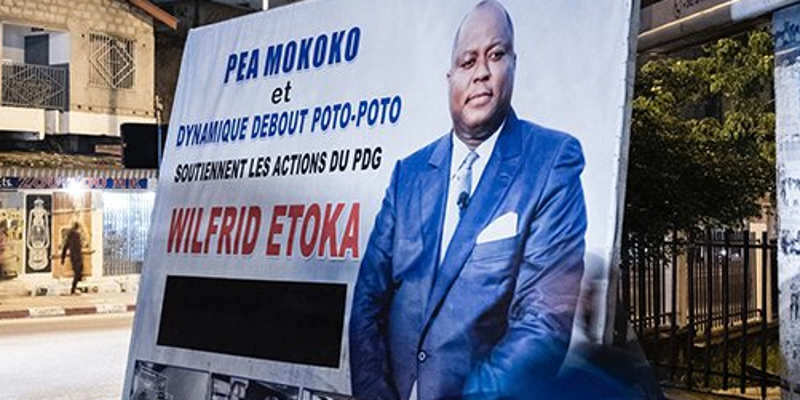
Etoka has benefited from close ties with Sassou Nguesso’s family. And according to Global Witness, one of the president’s nephews was appointed director general of PEPA.
“According to files from a French investigation, Etoka benefits handsomely from his dealings with Congo’s state oil company,” Becker and Schaap write. The state oil company, SNPC, awarded drilling rights in the Ngoki Block to Etoka’s company.
Global Witness lists some of Etoka’s business deals with the state:
His agribusiness Eco-Oil Energy operates 50,000 hectares of palm oil plantations previously run by state-owned enterprises. In 2015, the Congolese government also reportedly gave Mr Etoka’s company Congo Capital Enterprises the responsibility of privatising 46 state-owned firms across a range of sectors from logging to hydropower, acting as a broker with international investors. Most recently, he signed a joint venture with Congo’s agriculture ministry and a Chinese investor to set up a tractor factory.
Etoka signed a contract with the French company SMP Drilling for exploration work in the Ngoki Block in 2018. The first test drill took place in March 2019. SMP’s work ended in August 2019. The company would not tell the Spiegel whether it found oil or not.
SMP claims not to have been paid in full, and has filed a claim against PEPA for €4.5 million. A court in Brazzaville has ordered the “preliminary seizure of corporate assets belonging to Etoka’s company”, Becker and Schaap write. Etoka claims to have paid all bills to do with the test drill.
Highest international standards?
When asked about all this by the European Investigative Collaborations, the Central African Forest Initiative replied that its money was managed by the UN in accordance with the “highest international standards”.
The German Environment Ministry said that its aid money was not used to support any government institutions.
President Sassou Nguesso did not answer a question about whether he had exaggerated the oil discovery to cash in on CAFI’s money.
But when Etoka was confronted with the investigative journalists’ findings, he admitted that the Ngoki Block would probably only produce one-seventh of the amount per day announced in August 2019.
“Essentially, Etoka’s response is proof that the announcement of massive oil reserves in the Ngoki Block was a sham,” Becker and Schaap note.
Nevertheless, the oil project is set to continue.
The Central African Forest Initiative recently advertised six projects in the Republic of Congo totalling US$45 million. The projects include land use planning, agro-ecology, sustainable management of forests, sustainable energy for Brazzaville, improving the system to carry out Environmental and Social Impact Studies, and strengthening the capacity of NGOs.
Excluded from the list, predictably enough, is any attempt to stop the oil industry from setting off one of the biggest carbon time bombs on the planet.