
By Chris Lang
“There is no single solution to tackling climate change. A transformation of the global energy system is needed, from electricity generation to industry and transport. Shell will play its part. Our focus on natural ecosystems is one step we are taking today to support the transition towards a low-carbon future.”
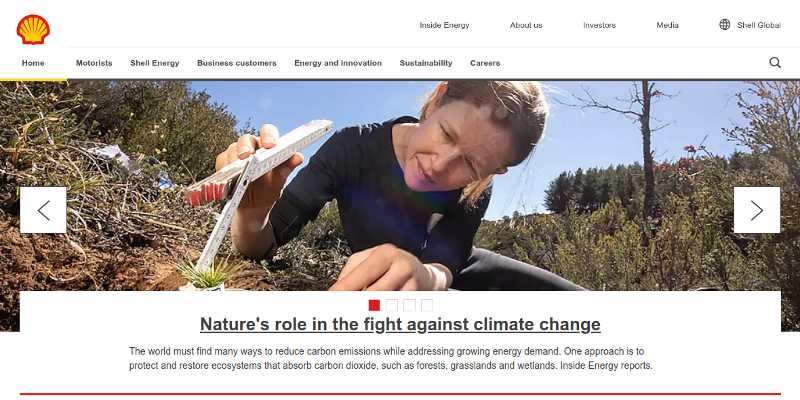
That’s Ben van Beurden, Chief Executive Office of Royal Dutch Shell. Yesterday, Shell announced that it will invest US$300 million in “natural ecosystems as part of its strategy to act on global climate change”.
From 17 April 2019, drivers in the Netherlands will be buying “nature-based carbon credits” when they buy Shell V-Power petrol or diesel. Those who buy other Shell petrol or diesel can choose to buy carbon credits for €0.01 per litre.
Shell and The Nature Conservancy
Shell’s press release also includes a comment from Mark Tercek, CEO of The Nature Conservancy.
Tercek welcomes Shell’s move to greenwash its climate pollution:
“Last year’s IPCC report was a wake-up call on climate: reducing emissions starts with fossil fuels. Shell’s announcement signals that one of the world’s biggest energy companies is pursuing a decarbonisation strategy with a broad set of solutions, including by investing in nature. By doing so, it is helping to curb global deforestation, restore vital ecosystems, and help communities develop sustainably. Shell is the first in the industry to set near-term targets for the emissions of both its operations and its products; this is clear progress, but it also illustrates how much work remains to achieve Paris climate targets. We look forward to seeing further investment from Shell in these areas.”
The Nature Conservancy has been working with Shell since 2009. On its website, The Nature Conservancy explains that, “Using the Conservancy’s research on natural climate solutions, this work aims to develop business strategies for the company that apply these solutions to help reduce the net carbon impact of the company’s products.”
In case there was any doubt, an article on Shell’s website explains that “Carbon credits are at the centre of Shell’s nature-based solutions.”
Shell and REDD
Shell describes itself as “one of the most established investors of carbon credits in the world”. The company buys carbon credits from two REDD projects:
- Cordillera Azul National Park REDD+ Project – a 1.35 million hectare national park in Peru. REDD-Monitor wrote about Cordillera Azul and carbon credits from sales of Ben & Jerry’s ice cream in November 2018.
- Katingan Peatland Restoration and Conservation Project – 149,800 hectares of peatland forest in Central Kalimantan, surrounded by industrial tree plantations.
Shell also buys carbon credits from the Green Trees Reforestation Project in the USA, and is planning new tree planting projects in the Netherlands and Spain, as well as conservation and regeneration projects in Australia and Malaysia.
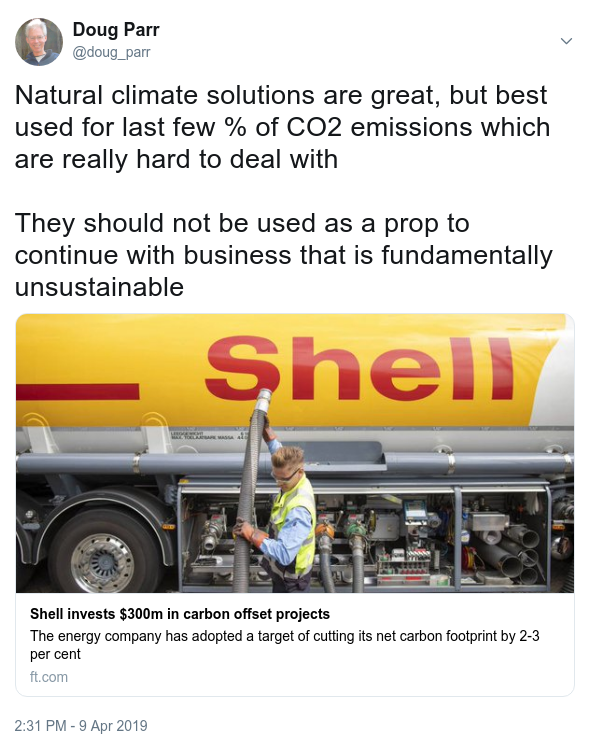
Shell’s US$300 million investment in carbon offsets is part of the company’s target to reduce its Net Carbon Footprint by between 2% and 3% over the next three years. It’s a tiny amount of money compared to Shell’s income of US$23.9 billion in 2018. An income that comes almost entirely from fossil fuels.
Obviously, Shell’s proposal of offsetting a tiny part of its emissions is a pathetically weak response to climate breakdown. Especially when it’s coming from one of the planet’s biggest climate polluters.
Another sort of Natural Climate Solution?
Last week, George Monbiot launched a Natural Climate Solutions initiative. Monbiot is one of my favourite writers. I read just about everything he writes and agree with practically all of it. He’s also an old friend.
But I’m worried that Monbiot’s Natural Climate Solutions initiative is doing too little to distance itself from Natural Climate Solutions like Shell’s US$300 million for carbon offsets.
On the Natural Climate Solutions website, Monbiot makes clear that, “We need both to leave fossil fuels in the ground and to extract greenhouse gases from the air.” I couldn’t agree more.
But elsewhere, the website gives the distinct impression of cosying up to the greenwashers. Monbiot’s Natural Climate Solutions website includes a list of “allies”, which are listed under this message:
There are several wonderful organisations already working hard to highlight and implement Natural Climate Solutions. Please follow these links and support their efforts.
I’m baffled by the fact that The Nature Conservancy is listed as one of these allies – an organisation that works with Shell (among other planet destroyers). The Nature Conservancy is actively supporting Shell to develop carbon offset Natural Climate Solutions to help greenwash Shell’s image.
Monbiot has opposed this sort of thing in the past. I hope he hasn’t changed his mind.
Yesterday, the carbon certification company Verra (previously called Verified Carbon Standard) was added to the list of allies on the Natural Climate Solutions website. Verra is a carbon trading company. A certification process is needed so that project developers can prove that the carbon credits they are selling actually exist. Without the certification process there could be no carbon trade.
Both of the REDD projects that Shell buys carbon credits from are verified under Verra’s certification system.
I’m also baffled by the fact that Monbiot, who opposes carbon trading, now appears to consider Verra, an organisation that exists only to enable carbon trading, to be an ally. Again, I hope he hasn’t changed his mind.
UPDATE – 21 May 2019: Verra has been removed from the list of “allies” on the Natural Carbon Solutions website. The Nature Conservancy is still there.
UPDATE – 22 August 2019: The Nature Conservancy has been removed from the list of “allies” on the Natural Carbon Solutions website.

When I wrote about Monbiot’s Natural Climate Solutions last week, I commented that,
I understand that leaving fossil fuels in the ground and natural climate solutions are “both and” rather than “either or” solutions to climate change. Nevertheless, a key concern is that using nature to address climate change could undermine the increasingly desperate need to stop burning fossil fuels.
Shell’s nature-based carbon credits are exactly that: an attempt to distract us from the urgent need to leave fossil fuels in the ground. I think Monbiot needs to address the fact that polluting industry and its carbon trading supporters co-opted “Natural Climate Solutions” long before he launched his new initiative.
George Monbiot wrote a great article this week about Shell’s greenwashing:

In the article he points out that “Shell has longstanding relationships with four “environmental partners”: the International Union for the Conservation of Nature, the Nature Conservancy, Wetlands International, and Earthwatch.”
Three of these organisations (IUCN, TNC and Wetlands International) are listed as “allies” on Monbiot’s Natural Climate Solutions website:
On 26 January 2022, George Monbiot wrote an excellent article about how Natural Climate Solutions have been corrupted by Big Polluters: