

The UNFCCC recently released a video titled “Keep calm and offset”. The basic premise is that we don’t need to stop driving, flying, or eating meat. We just need to buy carbon credits.
James Murray on Business Green has come up with 20 reasons the UN’s carbon offset video was a terrible idea. And on Climate Home News, Megan Darby has documented some of the reactions to the video.
Keep calm and offset
The video starts with an actor walking towards his car. When he tries to open the doors, the car disappears in a puff of smoke.
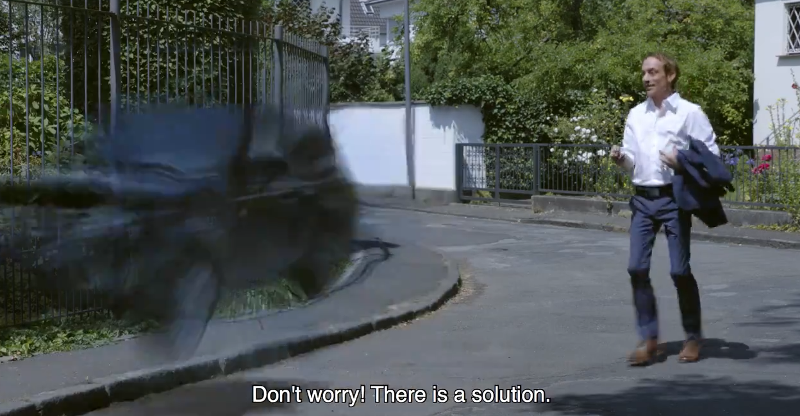
Then he’s by himself in an aeroplane:

Which also disappears, leaving him alone in the clouds:
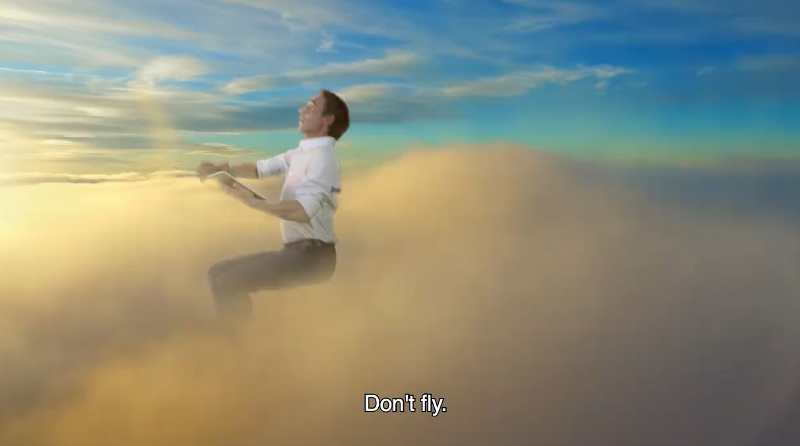
He drops (only slightly improbably) into his kitchen, where he’s told not to eat a plate of steak:
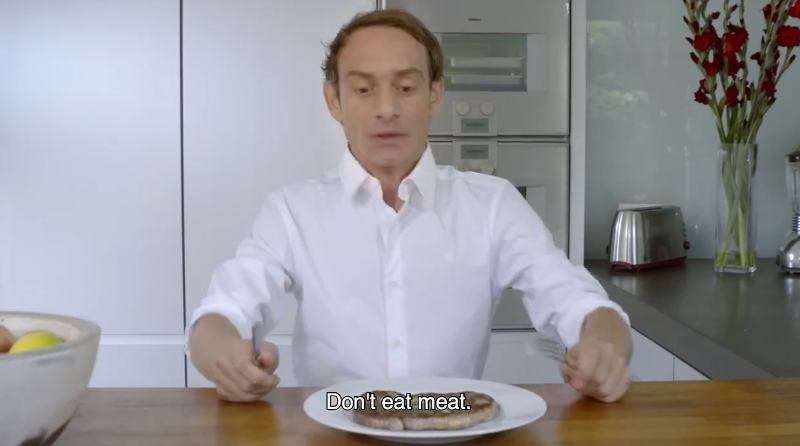
The steak also disappears. And the voice over says, “In fact, don’t do anything anymore and stop breathing please.”
While the actor holds his breath, the voice over tells him,
“Okay, we know that’s slightly impractical, so here’s the real solution: Go to our website, calculate your emissions, reduce them as much as you can and compensate the rest through our green projects. Oh, and you can breathe again now.”
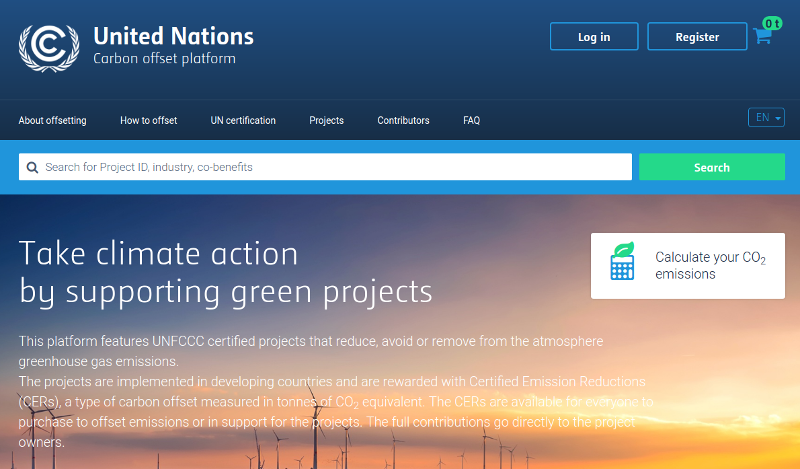
The website is the relaunched United Nations carbon offset platform, where you can calculate your carbon emissions and buy carbon credits:
Personal action matters
The video is dreadful. It pokes fun at people who take personal action on climate change. I know that political action is needed to address climate change. Reducing my personal emissions will not address the impact of the coal mining industry or the oil and gas industry.
Nevertheless, personal action is important. I’m vegan. I don’t own a car. And I don’t fly.
The UNFCCC carbon calculator is dubious, to say the least. I tried a few variations (to see how much further I could reduce my emissions). I filled in a series of zeros for the transport section. Nevertheless, transport accounted for 24% of my household’s emissions:
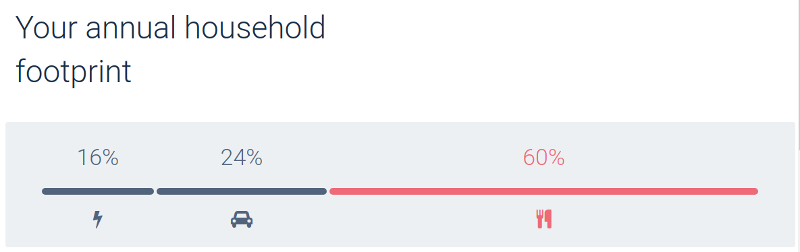
I was also surprised to see that food accounts for 60% of my emissions, considering that I told the calculator that I’m vegan, I always buy local products, always buy from environmentally responsible companies, and never eat out.
Offsets: Worse than doing nothing
The problem here isn’t that the UNFCCC somehow managed to sign off on a bad video. The video has now been taken down from Facebook and the UNFCCC’s tweets about the video have been deleted.
While the video has gone, the United Nations carbon offset platform still exists. And that’s the problem. The UNFCCC is still promoting offsetting as a means of addressing climate chaos.
Back in 2012, Kevin Anderson of the Tyndall Centre for Climate Change Research, wrote an article in Nature about why he opposes carbon offsetting:
Offsetting is worse than doing nothing. It is without scientific legitimacy, is dangerously misleading and almost certainly contributes to a net increase in the absolute rate of global emissions growth.
Anderson doesn’t fly. He explains why offsetting is not a solution:
Assume I broke my (self-imposed) seven-year refusal to fly, paid my £35 offset and boarded a plane from Manchester to London for the conference. In doing so, I add to the already severe congestion at airports, causing delays and allowing politicians to argue for greater airport capacity, arguments only reinforced by the rise in passengers turning to offsets. To meet increasing demand, airlines are encouraged to order new aircraft, which they promise will be more efficient. Feeling pressure, a future government approves new runways, but the extra flights and emissions swamp efficiency gains from the cleaner engines.
Meanwhile, in an Indian village where my offset money has helped to fund a wind turbine, the villagers now have the (low-carbon) electricity to watch television, which provides advertisers of a petrol-fuelled moped with more viewers, and customers. A fuel depot follows, to meet the new demand, and encourages others to invest in old trucks to transport goods between villages. Within 30 years, the village and surroundings have new roads and many more petrol-fuelled mopeds, cars and trucks. Meanwhile, the emissions from my original flight are still having a warming impact, and will do for another 100 years or so.