

Under the World Bank’s Forest Carbon Partnership Facility Peru aims to preserve 54 million hectares of forest. Under a 2014 REDD agreement with Norway and Germany, Peru pledged to reduce net deforestation to zero by 2021. Yet deforestation continues.
In April 2015, a company called United Cacao Limited hit the headlines internationally, following a report by the Environmental Investigation Agency. The Guardian reported that United Cacao was responsible for “illegally clearing swathes of rainforest in the Peruvian Amazon”.
United Cacao had cleared an area of 2,126 hectares of primary forest near Tamshiyacu in Loreto region, northeastern Peru. The deforestation took place between May 2013 and August 2014.
In August 2014, Peru’s government had ordered United Cacao to stop the forest clearing, but in April 2015, a court ruled that the clearing was legal.
UPDATE – 5 October 2015: The case has not yet been concluded. In April 2015, Julio Guzmán, Prosecutor for Peru’s Ministry of the Environment, submitted an appeal to a higher court.
The ambiguities, loopholes and weaknesses in Peru’s legal framework and environmental procedures enable illegal deforestation to take place. The reality on the ground is in direct contrast to the government’s lofty international statements about reaching “zero net emissions from land use change and forestry in Peru by 2021”.
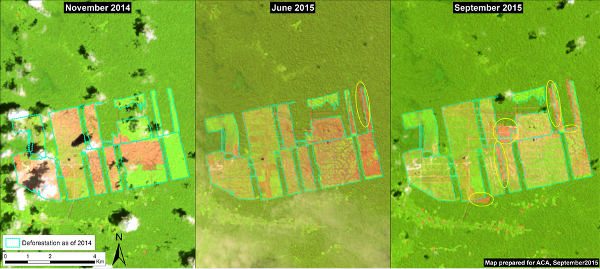
Recent satellite images published by Monitoring of the Andean Amazon (MAAP) show that a further 126 hectares was cleared between June and August 2015:
United Cacao: Listed in London, registered in the Cayman Islands, deforesting in Peru
United Cacao is listed on the London Stock Exchange and on the Lima Stock Exchange.
United Cacao is part of the Melka Group. In its report, the Environmental Investigation Agency describes the Melka Group as “a network of companies linked to massive deforestation and corrupt land deals in Malaysia”. The Melka Group’s corporate structure is opaque, involving a series shell companies and offshore accounts.
United Cacao is registered in the tax haven of the Cayman Islands. The company has even managed to make an agreement with the Cayman Islands’ government, which states that any tax laws enacted in the next 20 years will not apply to United Cacao.
The Melka Group has acquired 450 plots of mostly forested private land in the Peruvian Amazon. It is already operating on 7,000 hectares of forest and has requested almost 100,000 hectares of public land from the Peruvian government.
Dennis Melka is the Chief Executive Office of United Cacao. He says United Cacao, “seeks to become the world’s largest producer of ethically and sustainably produced cacao”. In March 2015, he gave an interview in which he attacks his critics:
All these really radical NGO groups will say “Oh my goodness, deforestation, rainforest.” I think it’s important to note that by the time the plantation companies actually get to the land, that land has been logged, or clearcut of all tropical hardwoods. There is simply, it is not a rainforest, it’s a secondary forest, it’s a highly degraded area. So I think there is a confusion about actually what rainforest is.
If there is any confusion, it’s entirely on Melka’s part. This satellite image unambiguously shows forests cleared to make way for United Cacao’s plantations:
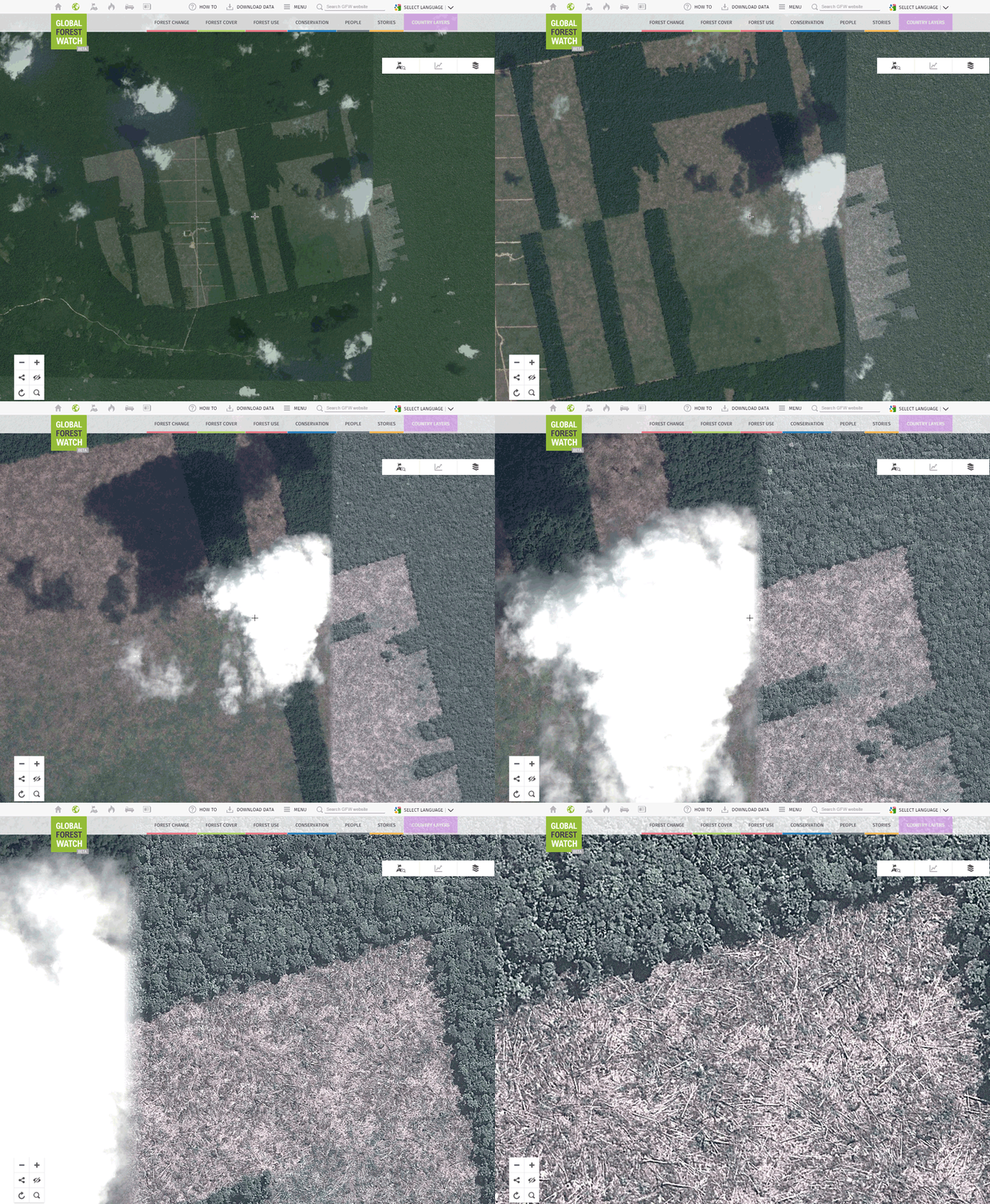
The World Resources Institute, the NGO that produced these images, is rarely (if ever) described as a “really radical NGO”.
Neither is the Center for International Forestry Research (CIFOR), which commented as follows on Melka’s operations in Peru in a report this year:
Local people in Iquitos were shocked when a newly cleared area was discovered by accident in Tamshiyacu, quite close to the city. This was one of Melka’s properties (for cocoa), but he had not received permission to deforest, as reported by the local paper (La Región 2013a). La Región followed this report with two more studies of the impending deforestation, described as “deplorable”, “fatal” and irrecoverable” (La Region 2013 b,c), and echoed in Pickett (2013) and Dammert (2013).
Melka’s record of destruction in Sarawak
Melka is no stranger to deforestation. In October 2009, he registered a company called Asian Plantations Limited in Singapore. By the time he sold the company to Felda Global Ventures in 2014, Asian Plantations owned 24,000 hectares of land for plantation development. The company’s share price had tripled and its annual revenue was almost US$24 million.
EIA looked into Asian Plantations’ plantation operations in Sarawak:
EIA’s research revealed the group’s involvement in large-scale land acquisitions of forested land, expansive deforestation, a complicated ownership structure, and the use of offshore tax havens as the location for the ultimate parent company of the group. Asian Plantations Ltd. was set up to acquire land and quickly profit from it…
Asian Plantations’ chairman, Leonard Linggi, has a history of getting his hands on logging concession in return for political favours to Sarawak’s ruling elite. EIA found that,
areas which correspond to four of Asian Plantation Ltd.’s five plantation land holdings are the same as those which appear as land transactions with companies owned by political allies and family members of the former Sarawak Chief Minister, Taib Mahmud.
Asian Plantations did not buy land in Sarawak directly, but did so through a network of subsidiaries. Three holding companies bought Malaysian companies that held the concessions. This multi-level, non-transparent corporate structure makes finding out the owners of concession more difficult, and helps Asian Plantations evade responsibility for deforestation.
In Peru, Melka is using a similar corporate model, through United Cacao and United Oils, both of which are registered in the Cayman Islands. His model of deforestation is also the same.
For those who speak Spanish, here’s a report about one of Melka’s oil palm operations in Ucayali:
Empresas de palma aceitera causan devastación y muerte en selva de Ucayali
And a Peruvian TV programme broadcast in August 2015:
You can’t reduce supply in one venue and not expect the demand to be met by production in another venue. The current supply side approach and only looking at leakage through a geographical key hole is seriously flawed. (or fraught with cognitive dissonance to use a currently popular term)